Driving adoption of your PBwiki (5-minute video)

We’ve been getting a lot of questions about how to drive adoption of your PBwiki in your organization.

Below, I’m including a 5-minute video on tips for successful adoption, plus some new tools we’ve created to make it easy for you to share PBwiki with your co-workers, students, or friends.

http://vimeo.com/moogaloop.swf?clip_id=1869970&server=vimeo.com&show_title=1&show_byline=1&show_portrait=0&color=00ADEF&fullscreen=1

Wiki Adoption from PBwikiWebinars on Vimeo.

Video Shortcuts

0:22 — What to expect when you deploy your wiki

0:58 — Three Steps to Success
– Starting with a core team
– Put yourself in your users’ shoes
– Weave your wiki into others’ workflow

1:14 — Go bottom up and horizontal!

1:26 — Wiki adoption patterns: Top down, bottom-up, sideways

1:38 — Avoid Blank Page Syndrome

1:44 — The biggest determinant of wiki Success

2:00 — Make logging in easier

2:16 — Keep using your wiki for various purposes (not just a one-time event)

2:45 — Gentle onboarding: How to help new users get used to your wiki

3:20 — Weave wikis into workflow

4:16 — Other tactics to drive adoption of your wiki (include your wiki in your signature, “This should be on our PBwiki” stickers)

5:00 — Create editing cycles so users don’t hit a brick wall

Need more resources? The best place to learn more about driving adoption is our Driving Adoption wiki, which includes detailed tips and tricks, presentations, and case studies for integrating PBwiki into your organization.

Effective Communication – A Peace Corps and PBwiki Case Study

Jason Samuelian is a Peace Corps volunteer in Lesotho who introduced wikis to volunteers throughout the nine current Southern Africa countries that have Peace Corps volunteers. You can check out his public wiki here. Here is Jason’s case study, in his own words.

So, why did you need a wiki?
You see what we are trying to do is build a space on the internet where the volunteers can share information and ideas on how to further the development projects in their countries. We are doing this outside the confines of Peace Corps Washington and therefore it is on our measly salaries to get this thing off and running.

How are you using your PBwiki?
We are using PBwiki to provide resources for Peace Corps volunteers in the Southern African region. Such as the sharing of project ideas, resources, recipes, weather, experiences we have faced, etc. The main purpose behind the wiki though is too make volunteers more successful in their service by giving the easy access to volunteer ideas and information that has already been field tested by their predecessors.

How has using a wiki changed the work you do for the Peace Corps?
The Peace Corps does give us a significant amount of initial training and they provide computers for us to work on throughout our service. The common practice though by most volunteers has been to make say a lesson plan or an outline of how to run a sports camp to raise awareness to HIV/AIDS.

However the two components have never been brought together. What we thought would be helpful was to make this information available to people before the even come to the country. This way we could get the new volunteers thinking about what they might want to try and give them ideas after they have gotten to their site and maybe been discouraged by a failed project or idea.

Continue reading “Effective Communication – A Peace Corps and PBwiki Case Study”

How to encourage non-technical people to use a wiki

Most people at your company have never even heard of a wiki, so how do you get them to actually use it?

Raoul Kahn, Director of Product at Seesmic, had the same problem that many of you face at your own company. Here is his advice on encouraging wiki adoption – particularly with non-technical people.

http://vimeo.com/moogaloop.swf?clip_id=1868934&server=vimeo.com&show_title=1&show_byline=1&show_portrait=0&color=00ADEF&fullscreen=1
Raoul Kahn from Seesmic talks about PBWiki from PBwiki on Vimeo

The Breakdown

:35 – How to get non-technical people involved
1:56 – Three ways Seesmic uses their business wiki
2:46 – Who used the wiki immediately (hint: no one) and how to get people on board
3:22 – How to explain to non-technical people why and how to use a wiki.

“It’s made my job so much easier. I can look at one site, where ever I am and I know what’s going on”

How do you encourage people at your company to use a wiki?

See David Weekly at the SDForum Cloud Computing Conference

Are you a cloud computing user?  If you use PBwiki, you are.

Not only is PBwiki a Software-as-a-Service (SaaS) solution, but we also run significant portions of our infrastructure “in the cloud.”

If you’re interested in cloud computing, or in how PBwiki uses cloud computing to lower its costs and deliver better service, check out David’s panel at 10 AM on Wednesday, October 1.

While you’re there, you should probably check out the rest of the conference as well.  Here’s how SDForum describes it:

The burgeoning availability of computing resources “in the cloud”, while still something that’s only being utilized by early adopters and for small projects, is going to transform software development as much as any of the revolutions mentioned above.

Join SDForum as we present our first-ever Cloud Computing conference. This daylong event will address the issues and controversies surrounding cloud computing help you to understand the technologies and risks involved, and enable you to figure out what, exactly, your company should do to take advantage of the ongoing revolution.

Click here for more information about the conference.

Click here to register for the conference.

PBwiki cruise lines

When you think of taking a vacation cruise, you probably think of all the food you’ll eat, shuffle board you’ll play, and booze you’ll drink. But what do the folks running the ship think about? My bet is they think about some of the same things I think about everyday: keeping the ship operating smoothly, charting a halcyon course, and making sure that process never enters the minds of its customers. Come with me for a tour of the ship we pilot for the pleasure voyage we like to call pbworks.com.

Surf\'s up on PBwiki traffic

“Safety first” isn’t just the mantra of cruise liners and middle school crossing guards, we take it seriously here, too. Your data is kept on three different PBwiki machines, then additionally encrypted and backed up off-site. How much data are we talking about? Your average desktop computer can hold about 200GB of data, of which about 6GB is your illegal music collection. We track over 25 times that amount: 5400GB of your data. In the past year we’ve had to triple the number of servers we use to store it all!

Engines are pretty important to cruise ships, but they’re also complicated and can break down. Putting in multiple engines is difficult and expensive, but it’s worth it: if one breaks down, you’ve got a spare. PBwiki is the same way with computers. Over the last year, we’ve worked to add “hot standby” servers that automatically take over if another computer experiences a failure. Ever wish you could just switch computers when Word or Windows crashes and pick up where you left off? With PBwiki you can!

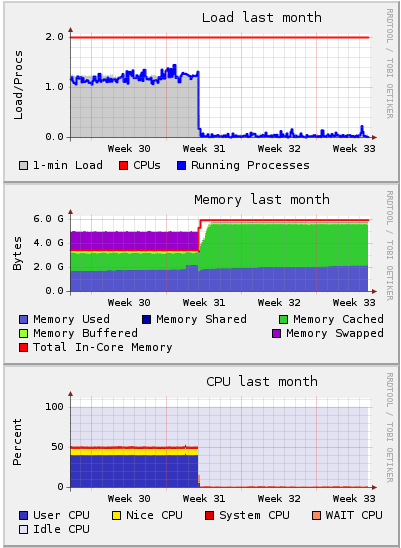
Expanding RAM and capacityCaptains don’t drive a ship blindfolded, and neither do we. Earlier this year we fully instrumented our machines and services with a program called “ganglia.” It takes measurements and displays them on our dashboard so we can detect problems and calculate trends. The graph at left shows the effects of adding RAM to a beleaguered backup database: CPU usage drops and we are even more prepared in the unlikely event of a problem.

Although calling it a “captain’s log” would evoke too many Star Trek jokes, our Operations team logs all changes to the service, so we have a point of reference when tracking down performance issues, or to make sure certain checks were made. We keep it on PBwiki itself and simply call it the “log.”

Of course, this metaphor only goes so far: I haven’t yet secured the right to use deadly force to suppress piracy and mutiny. Apparently that would be against the “laws” and we haven’t relocated to my ideal office in international waters. Join me next time when we go into more technical details about PBwiki’s commitment to operational excellence!

Earn your free classroom upgrade and learn how to wiki

Join the PBwiki Back to School Challenge to earn a free gold upgrade, plus the chance to win tons of classroom resources.

In addition to earning awesome classroom swag — legos, books, and gift certificates for school supplies — the PBwiki Back to School Challenge will teach you how to:

  • Build an interactive website – add video and images to your existing lessons
  • Develop group projects and encourage collaboration and participation
  • Find out how other educators have built their wiki
  • The Back to School Challenge is the best way to learn how to use your wiki and earn a free upgrade along the way.

David Weekly Speaks @ Tec de Monterrey

There are a lot of people, organizations, and governments that are interested in the innovative culture of Silicon Valley as well as PBwiki’s unique structure that focuses on hiring (and listening to) some of the brightest people in the world. We’ve hosted a delegation from the French government in our office, spoken to SwissCom, and most recently our founder, David Weekly, gave several talks in Mexico. Here’s the slides for the talk he gave this month at ITSEM, one of the most prestigious business schools in Mexico.

http://static.slideshare.net/swf/ssplayer2.swf?doc=innovation-culture-1219277256580928-9&stripped_title=innovation-culture-presentation

Watch a video of this talk (in three parts). You can also see David’s pictures on Flickr from his trip to Mexico City, which includes a tour of some of the major pyramids and rafting down the Filobobos River in Tlapacoyan.

You can also watch David’s July 14 talk at University of Sonora in Hermosillo, Mexico. The talk resulted in a SuperHappyDevHouse being thrown in Hermosillo the next month; it was attended by PBwiki employee Joel Franusic and was the first in Latin America. (Video)

New free feature: Wiki color schemes

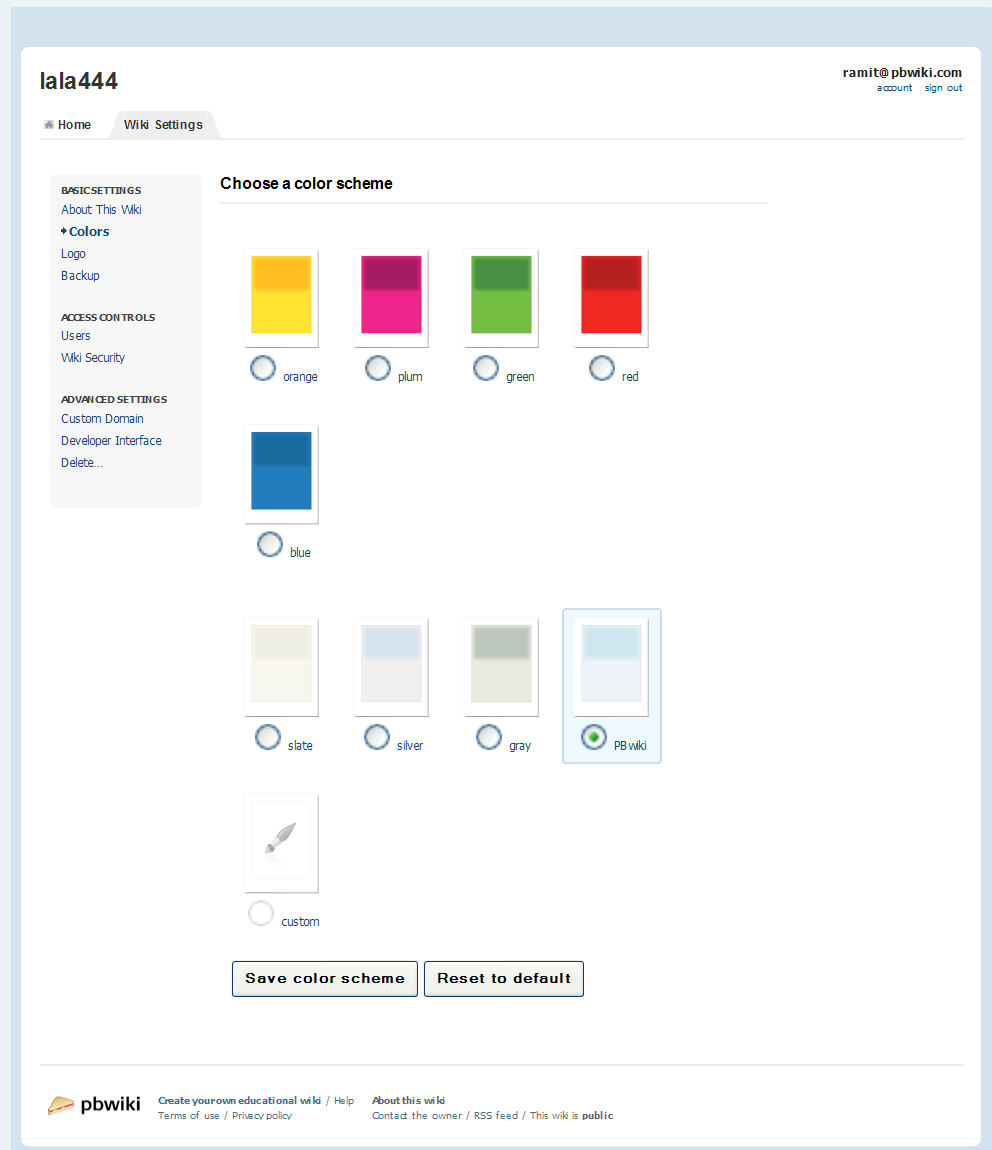
Starting today, color schemes on all 2.0 PBwikis are free!


Custom colors in PBwiki -- now a free feature 

Earlier, color schemes were a Premium feature. But since we’ve heard more and more of you asking to use colors to customize your wikis, we realized it makes sense to offer them to everyone.

With the release of the new settings panel, we’re giving away all 9 of the pro color schemes to all our wonderful users, free of charge! These include colors like Silver, Plum, and Blue.

To add a new color scheme to your wiki, click “Settings” in your 2.0 wiki.

Let us know what you think!

Update: Edited for clarity. The “Custom” color option which allows you to create your own color scheme is still a Premium feature.


Back To School Blitz: Free Upgrades and Gifts

We’ve just announced two new back to school programs for educators that will let them get free Gold upgrades and other gifts like LEGO sets and up to $1,000 for buying school supplies. Here are the details:


Program for Teachers and Librarians

PBwiki’s Back To School Challenge
(http://www.backtoschoolchallenge.com) allows up to 100,000 individual
teachers and librarians to sign up and earn a free one-year Gold Upgrade
(regular price $250) by using, blogging about, and referring others to
PBwiki. In addition, top performers in the challenge will receive donations
such as a $1,000 gift certificate from PBwiki for purchasing school
supplies, educational products from LEGO(R) Education (The LEGO Group’s
educational division), autographed books from award-winning science author
Janice Van Cleave, and the bilingual board game GiftTRAP (named “Best Party
Game” by both Games Magazine and Creative Child Magazine). “With sales of
more than two million copies, and translations in fifteen languages, my
books are tools used by educators around the world to expand science
education beyond the textbook,” said Van Cleave, the author of popular
books such as Janice VanCleave’s Teaching the Fun of Science. “By enabling
collaboration, wikis can add binomial expansion to the educational value in
my books.” For a list of these donations, visit the PBwiki web site
(http://pbworks.com/content/btsc-sponsors).

Program for School Districts and Educational Organizations

PBwiki’s Partner Program for Education allows school districts and
organizations that standardize on PBwiki to offer free one-year Gold
Upgrades (regular price $250) as an exclusive membership benefit. Already,
organizations such as the Mathematical Association of America, and the
Wisconsin Society of Science Teachers have signed up to offer PBwiki to the
individual educators they serve. “We use PBwiki to help promote our annual
meetings, and as a collaborative tool for a variety of special projects,”
said Michael Pearson, Associate Executive Director of the Mathematical
Association of America. “There is growing interest in the use of wikis and
other interactive, web-based tools for the classroom. Providing a free
trial of PBwiki will allow our members to experiment and learn how to use
wikis to benefit their students.” School districts and organizations
interested in joining the program should visit the Partner Program page
(http://pbworks.com/content/edupartners).

The Back To School Challenge and Partner Program for Education run
through October 31, 2008.


But don’t take our word for how cool this is…here’s what CMSWire had to say:

“These applications and services will allow teachers and students to collaborate in ways that students have never imagined. The uses are virtually unlimited.

Most of us here at CMSWire probably can’t even count the ways we could have utilized such technologies back when we were in school.

The effects of this could inspire students and teachers to familiarize themselves with technology, Web 2.0, and collaboration. This won’t keep students out of the principal’s office for using their cell phone during class, but it is nice to see companies like PBwiki giving back to the educational system. More companies should have similar programs.”