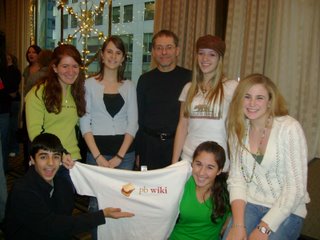
PBwiki

That’s geek code for “PBwiki loves South by Southwest!” One of the advantages of a tool that’s simple to get set up and running with like PBwiki is that you can use it to make quick, ad-hoc workgroups at conferences like South by Southwest. If you’re looking to post your own itinerary or put together a spontaneous birds-of-a-feather session, come set up a new wiki with us and email david+sxsw@pbworks.com with the address and I’ll add it to the official PBwiki SXSW page.

Cheers,
David Weekly
Founder & CEO

The Elephant and the Ant: Why Companies Need Processes As They Grow

Seth Godin had a recent post about how organizations tend to go from crisp to soggy over time.

While I agree with his points, I think that there’s a better analogy to explain why companies need processes as they grow.  I call it the principle of the elephant and the ant.

Hollywood horror movies nonwithstanding, you can’t scale up an ant to the size of an elephant.  The mechanisms that work so well for a one-gram ant don’t work for a 10-ton elephant.

The ant is like a startup: It’s small, nimble, and surprisingly strong for its size.  When you’re that small, you don’t need a lot of internal structural elements–a thin exoskeleton more than suffices.  It doesn’t even need lungs to breathe, relying instead on its surface area to allow oxygen back and forth.

Similarly, startups don’t need a lot of internal processes or documentation.  When your entire company consists of three people in a single office, everyone and everything in your company is in touch with the outside world.  If something comes up, you just poke your head over your laptop and fix it.  An “all-hands” meeting consists of nudging the co-founders to your left and your right.

But as your company grows (which is almost always necessary if you build a successful business), that approach doesn’t scale.  You don’t see 1,000 person companies being run like a 3-person startup for the same reason you don’t see ants the size of Volkswagens.

(Be glad that we don’t!)

Instead, your company begins to resemble the mighty elephant.  The lightweight exoskeleton is replaced by a thick endoskeleton.  All sorts of internal structures like lungs are required to support life.  And you can bet that an elephant can’t scurry at a rate of 5 times its body length per second, or lift 50 times its own weight.

Big companies need endoskeletons to function.  Yes, these processes impair flexibility, and force you to trade in the elegantly slender legs of the common ant for the stubby tree-trunks of the ponderous pachyderm, but the alternative isn’t pretty.  A 10-ton ant would instantly collapse and die under its own weight, unless beaten to the punch by asphyxiation.

And there are benefits to being big.  You may not be able to run as fast or lift as much on a relative basis, but an elephant can definitely cover longer distances than an ant, and no ant in the world can lift an entire tree with its trunk.

Both elephants and ants have their place in this world, just as crisp and soggy do.  The trick is making sure that your approach is appropriate to your situation.  There’s a reason why invertebrates are smaller than vertebrates, but mice are smaller and faster than lobsters–only you can decide what the right answer is for your company.

P.S. One final alternative to keep in mind: While a single ant can’t move a rubber tree, an army of them certainly can (or at least decimate the village where the tree is planted).  To what extent can your company act like a swarm of startups, rather than as single elephant?

Customer Expectations: Best Approaches

All businesses know that the degree of customer service excellence is relative – it’s based on customer expectations. Many profitable companies do poorly on customer service and they thrive – which begs the question: is it smart to invest in customer service?

This is why it is absolutely critical to measure customer experience at the beginning.

Key Questions:

  • What are the customer’s expectations?
  • Is it different across industries, market segments or channels?
  • How is the experience within a particular industry, segment or channel helping or hurting?

The last thing we want to do is overspend on customer service, but without an understanding of the components of the experience and a measurement of the success of the experience – it’s difficult to pinpoint areas of improvement and create appropriate initiatives to deliver on those.

Discovering the gaps between the customer’s expectations and your brand’s promise is the most important work that your customer service organization can do.

How one author uses PBwiki to let anyone edit his New York Times bestseller

Tim Ferriss is the author of The 4-Hour Workweek, a book that’s become phenomenally successful. (The book is about “lifestyle design” and working less to achieve your goals, including some provocative ideas about outsourcing your life.)

After simultaneously being listed as a bestseller on the Wall Street Journal, New York Times, and Businessweek lists, Advertising Age listed it as one of 2007’s best product launches.

51fsazava3l_ss500_.jpg

In fact, we have a few copies of the book in our office.

For the second edition of his book, Tim decided to use PBwiki to edit his New York Times bestseller. On the 4-Hour Workweek wiki, he asked his readers to point out corrections, add ideas, and suggest examples for the newly revised 4-Hour Workweek.

The 4-Hour Work Week wiki launched last night around 11pm and already has hundreds of visitors and dozens of high-quality edits.

This is a great way to use PBwiki. By allowing his readers to add their thoughts, Tim taps into their collective knowledge. And because he has a Premium wiki, he can assign his editors “Contributor” access so anything they do is reversible (e.g., no deleting pages!).

Learn more:

If you’re interested in using PBwiki for managing a project — or writing your own New York Times bestseller! — create a free wiki at PBwiki.com.

Missing: Watson the Wiki Shirt

Last week I received a desperate email in my inbox…

“I have a problem and I am wondering if you can fix it for me. I am a senior at Randolph high school and am a peer teacher for Ms. Eberheart a biology teacher. She is very big in to using PBwiki. She is so into it that she got a t-shirt from you.

As a fun thing Ms. E has her students take it around when they go to special places and then have them write a blog about it. The reason I write to you is because she gave me the shirt to take to the giants parade and it was stolen from me. I gave it to a player to sign and when they threw it back another person picked it up and walked away with it I went to look for it but I could not find it. Could you help me out and maybe send Ms. Eberheart another shirt so she can continue her project with the shirt.

Mrs. E receives two snaps from the PBwiki team. She thought of a creative way to engage her students in biology, new technology AND creative writing. You can see her blog here. What interesting ways have you found to introduce technology into your classroom?

watsonwikishirt.jpg

Enjoy telling folks about PBwiki? Why not make it your job?

Are you a software sales professional?  PBwiki is looking for salespeople that want to work for one of the fastest growing software companies in the world.  We are looking for proven, quota-carrying sales professionals.

We have positions open in both our San Mateo, CA and Nashua, NH offices (so if you’ve always wanted to work for PBwiki, but couldn’t bear to leave your beloved Red Sox behind, now you can live the dream!).

Read more about the position and send in your application.

To Sell Your Story, Be The Story


For this week’s marketing post, I’m going to delve into the world of politics again, which holds some interesting lessons for the business world. 

One of the major advantages that Barack Obama currently holds over Hillary Clinton in the race for the Democratic presidential nomination here in the United States lies in how his campaign has managed the media.

Clinton’s campaign has complained that the media coverage is more sympathetic to Obama (which is pretty evident to anyone who watches CNN or MSNBC), but a bigger issue is simply the volume of coverage.

In political contests, pundits often refer to the “air war” and the “ground war.”  The air war consists of media exposure (either paid advertising or press coverage)  to drive awareness, while the ground war consists of the door-to-door organization to get out the vote.

In many ways, this division resembles the classic divide between Marketing (air war) and Sales (ground war) in business.

When it comes to the air war, the key is to drive awareness.  As I’m fond of saying, your most potent competitor is generally ignorance.

Because Barack Obama has become a magnet for free press coverage, he has a significant advantage over Hillary Clinton in the air war.  Every time he holds a 15,000-person rally at a sports arena, with thousands more spilling out into the streets, it’s a newsworthy story that can draw national coverage, and perhaps even more importantly, local news coverage in both print and TV.

It’s possible to substitute money for coverage by blanketing the airwaves with paid advertising, but as Mitt Romney has demonstrated, pound for pound, paid ads are less valuable than free coverage.

The advantage that free coverage brings can be seen in the relative fortunes of the Obama and Clinton campaigns.  While both have raised roughly the same amount of money since 2006, Obama’s press advantage also allowed his campaign to spend more on the ground game than Clinton, while still maintaining a larger warchest.

The same principle applies in business.  If you can get the press to do your job for you, why spend money buying ads?  What’s more valuable, a 1-page ad in Fortune, or a glowing article?  And don’t forget, that article didn’t cost you $25,000.

The key question then is, how do you get that press coverage?

You can spend a ton of money ($20,000+ per month) on high-priced PR agencies, but as the example of Hillary Clinton shows, the best spin machine in the world can’t help much if you don’t have a story people want to write about.

Barack Obama has been successful during the nomination battle not because of his spinmeisters, but because he successfully embodies a story that people want to hear and retell.  What American doesn’t want to believe that anybody (including an African-American with a Muslim name and father, raised by a single mother) can grow up to be president?  And if people want change and a break with the past, there is no way for Hillary Clinton to argue that she is best positioned to deliver it.

Great marketing isn’t about selling your story.  It’s about being the story.

The same applies to the business world.  Google famously refuses to spend any money on advertising.  Guess what?  They don’t have to, because they are the story.

Microsoft can spend far more money than Apple on ads (and it does).  But Apple always wins the air war (at least during the iPod era) because it is the story.

To sell your story, be the story.

PBwiki is heading to the NBA All-Star Game!

Uber-blogger Henry Abbott of TrueHoop (now part of ESPN) is heading to the NBA All-Star Game, and he’s taking PBwiki with him.

Henry has asked TrueHoop’s tens of thousands of readers to join with him in creating a wiki for the All-Star Game which will include articles, posts, videos, and other original content.  And he’s chosen PBwiki.  Here’s what Henry had to say:

Let’s use that wiki to assemble, starting now and running all weekend, all of the best articles, blog posts, video, and original anecdotes about what’s happening all over the city. Not just the stuff that’s in press releases, but what’s really happening on the ground.

If you’re from New Orleans, and have a story to tell about having the All-Star game in your city, please share it here. If you find a great article or video about New Orleans, this is the place for it.

Basically, I am hoping that with your help this can become a go-to resource of the best real New Orleans information as All-Star Weekend rolls on. It’ll take a lot of you pitching in with thougtful contributions. But if you do, this’ll really be something.

Also, I’ll be honest, in the past I have found wikis kind of hard to operate. Not this one. It’s really simple. Try it. (emphasis added) Here’s the link again. Thanks.

Credit the assist to David Cohn of DigiDave fame for setting up the wiki.  Big thanks to both Henry and Dave for introducing PBwiki to such a broad audience.

If you want to visit the wiki, just go to http://truehoop.pbworks.com.

PBwiki Preview: The improved editor in PBwiki 2.0

One of the strongest pieces of feedback we’ve gotten is to improve our editor.

Good news — PBwiki 2.0 includes a new editor that makes using your wiki far easier. I’ve been using it internally and it’s fantastic.

PBwiki 2.0 improved editor
Click to enlarge

What does the new editor include?

  • Better handling of bullet points and numbered lists.
  • Better handling of line spacing and fonts.
  • Much more WYSIWYG-ness.” (That’s straight from our Director of Engineering.) Edit mode will look much more like the final version.

When we launched our Point-and-Click editor a year ago, we noticed a quick upsurge in our usage. The easier it is to edit, the more people use PBwiki. So among our other new features, We’re very excited to show you the new editor.

Golden Tickets: Get beta access to PBwiki 2.0
We have a limited amount of Golden Tickets to try out PBwiki 2.0 as a beta user. If you’re interested in trying out PBwiki 2.0 and giving us feedback, sign up for PBwiki 2.0 beta access.

[See our past Previews of PBwiki 2.0: Folders, Page-level access and an Overview of PBwiki 2.0.]

PBwiki in Fortune Small Business / Tips On Driving Adoption

Fortune Small Business just wrote a nice article about how Lee Rosen of Rosen Law used his creativity to drive adoption of his PBwiki.

Rosen offered a $1,000 cash prize to his 32 employees–for every page they created on the wiki, they earned a possible combination to the company safe (which contained the aforementioned $1,000).  At the end of three months, the prize went to Ben Sutton (pictured below).

But Lee had the last laugh–by switching his people over to PBwiki, he saved $25,000 per year that he had been spending on running a Lotus Notes server.  And money wasn’t the only benefit:

“The biggest reason that we’re switching is that the wiki is easier to use,” says Rosen. “If employees see a better way to organize or present information, they can just go ahead and do it with a wiki. With Lotus Notes, it required a programmer.”

Maybe you don’t have $1,000 to spare to drive adoption of your wiki, but maybe you can modify Rosen’s technique to fit your organization.  How about giving your top user tickets to the game, or a night out on the town?

If you get your entire company using PBwiki, the benefits will far outweigh the cost.

Click here to read the Fortune Small Business article.